

To split your paycheck, pay the bills that land before your next payday, take a fixed share of what remains for savings, and spend the rest. The percentage rules people quote, 50/30/20 and 70/20/10, are a shape to aim at. The number that decides your week is what this paycheck has to cover before the next one arrives.
Start from the paycheck, not the month
Almost every budget you will read is written for a calendar month. Most people are not paid monthly. The most common American schedule is every two weeks, which is 26 paychecks a year rather than 24, and two months a year that hold three paydays instead of two.
A monthly budget hides that. It tells you rent is 31% of your income, which is true across a year and no use on a Friday. So the split is not a decision you make once. You make it every payday, against the bills that fall before the money arrives again.
The three rules worth knowing
Every allocation rule is the same idea with different numbers. Pick one, adjust it, and stop looking for a better one.
Half to needs, 30% to wants, 20% to savings and to debt above the minimum payments. The most quoted, and the hardest to hit anywhere rent is expensive.
70% to living costs, 20% to savings, 10% to debt or giving. More forgiving when housing takes more than half of what you earn.
Decide the savings figure, move it on payday, live on the rest. Not a percentage at all, which is why it survives a month that goes wrong.
Bills first, because they are not evenly spread
Percentages assume your costs arrive in a smooth stream. They do not. Rent lands on the 1st, the car payment on the 12th, the insurance renewal once a year.
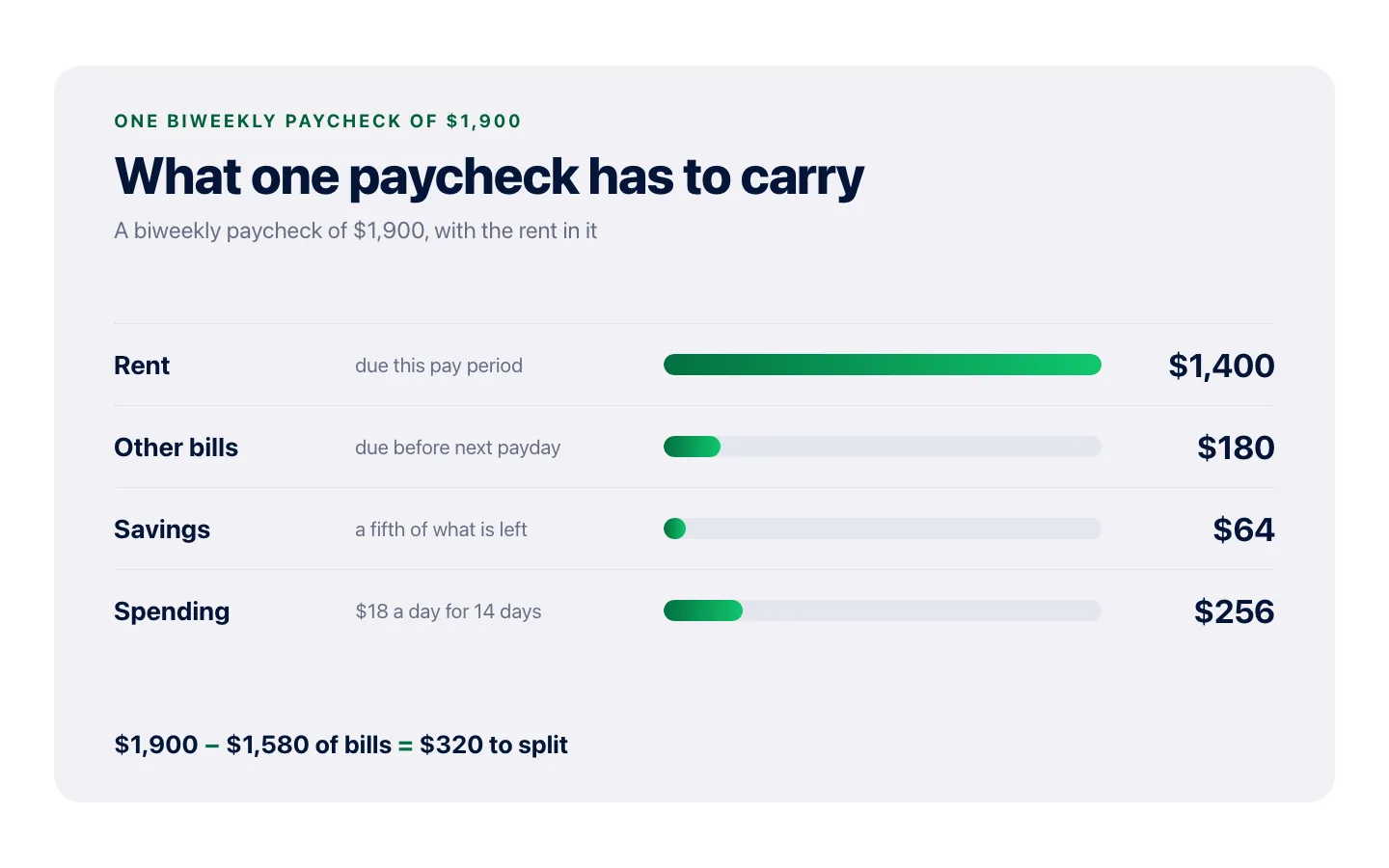
Before any percentage, write down what is due between today and your next payday and subtract it. That remainder, not your gross pay, is the money you are splitting. If you have never written that list out, a list of the categories worth tracking is a faster start than inventing one from memory.
How to split your paycheck in three steps
Not the monthly total. Only what falls inside this window.
A percentage of the remainder, or a fixed figure you set once.
Divide it by the days if that helps.
A worked example, on biweekly pay of $1,900 after tax. Rent of $1,400 falls in this pay period, and $180 of other bills are due before the next payday, which leaves $320. A fifth of $320 is $64 to savings, and $256 to spend across fourteen days, which is $18 a day.
The next paycheck has no rent in it. The same $1,900 leaves $1,720, then $344 to savings and $1,376 to spend. The rule did not change. The paycheck did.
The same rule on weekly, biweekly, twice-monthly and monthly pay
The arithmetic is identical on all four. The rhythm is not, and the rhythm is what people get wrong.
52 paychecks, each of them small, and one bill can swallow an entire week. Take savings as a fixed dollar amount here, because a fifth of one week is small enough to skip.
26 paychecks. Two months a year hold three paydays, and those two are where a year of savings is usually won or lost.
24 paychecks on the same two dates. The easiest to match to bills, because rent always lands in the same half of the month.
The percentage rules work as published, and the difficulty moves to the end of the month.
Biweekly pay has the extra wrinkle, and a guide of its own: budgeting on a biweekly paycheck works through the three-payday months in detail.
What to do when the percentages do not fit
Sometimes the numbers refuse to leave 20%, and no arrangement of them will.
No percentage fixes a housing cost. Work on the cost or on the income, rather than on the arithmetic.
Most providers will change a due date if you ask, and shifting one bill by nine days can level out a year.
Money with no job attached does not survive the weekend.
The annual costs that always arrive as a surprise are the obvious place to start, and sinking funds are how you stop them being surprises.
Splitting your paycheck without splitting your direct deposit
Half the advice on this question is about payroll. Many employers will send part of each paycheck to a second account automatically, and for savings you would rather not see, that works. It is not a plan, though. A fixed amount to a fixed place does not know that rent is due on Tuesday.
Do the plan first. If the plan says $64 a payday to savings and you would rather not move it by hand, set the payroll split to $64 and let it run. The split follows the plan, never the other way round.
Doing this in Cashrou
Cashrou plans one pay period at a time, which is what this article asks you to do by hand.
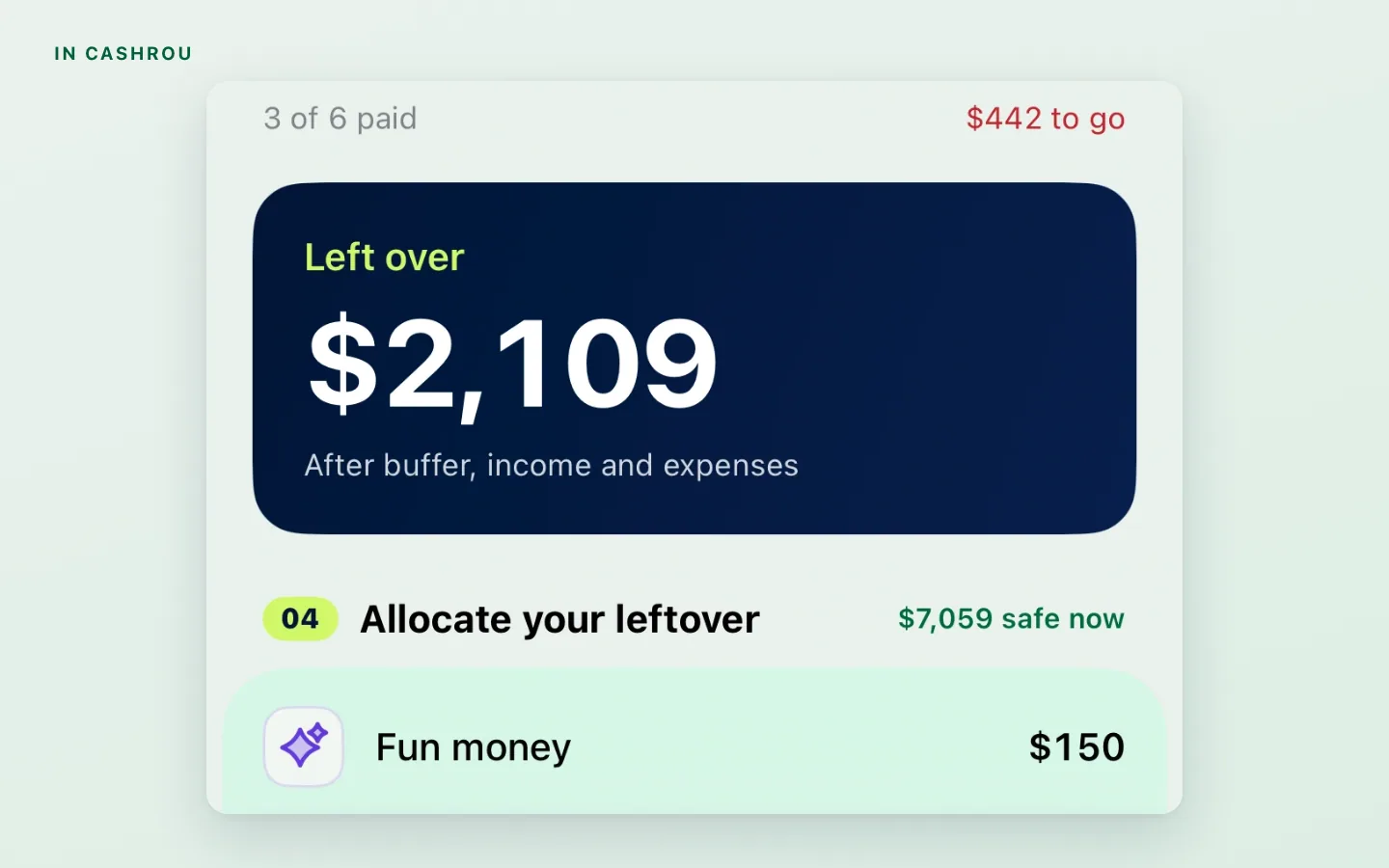
You enter your income and its schedule, weekly, biweekly, twice-monthly or monthly, and your bills with the dates they land. Each payday then shows what that paycheck has to cover before the next one, and what is genuinely left, rather than a monthly average.
The leftover is split from there. Point part of it at a goal, which reads its progress from the account that holds the money, and leave the rest as spending. There is no bank connection, so nothing is imported and nothing is guessed. The features page has the rest of what it does.