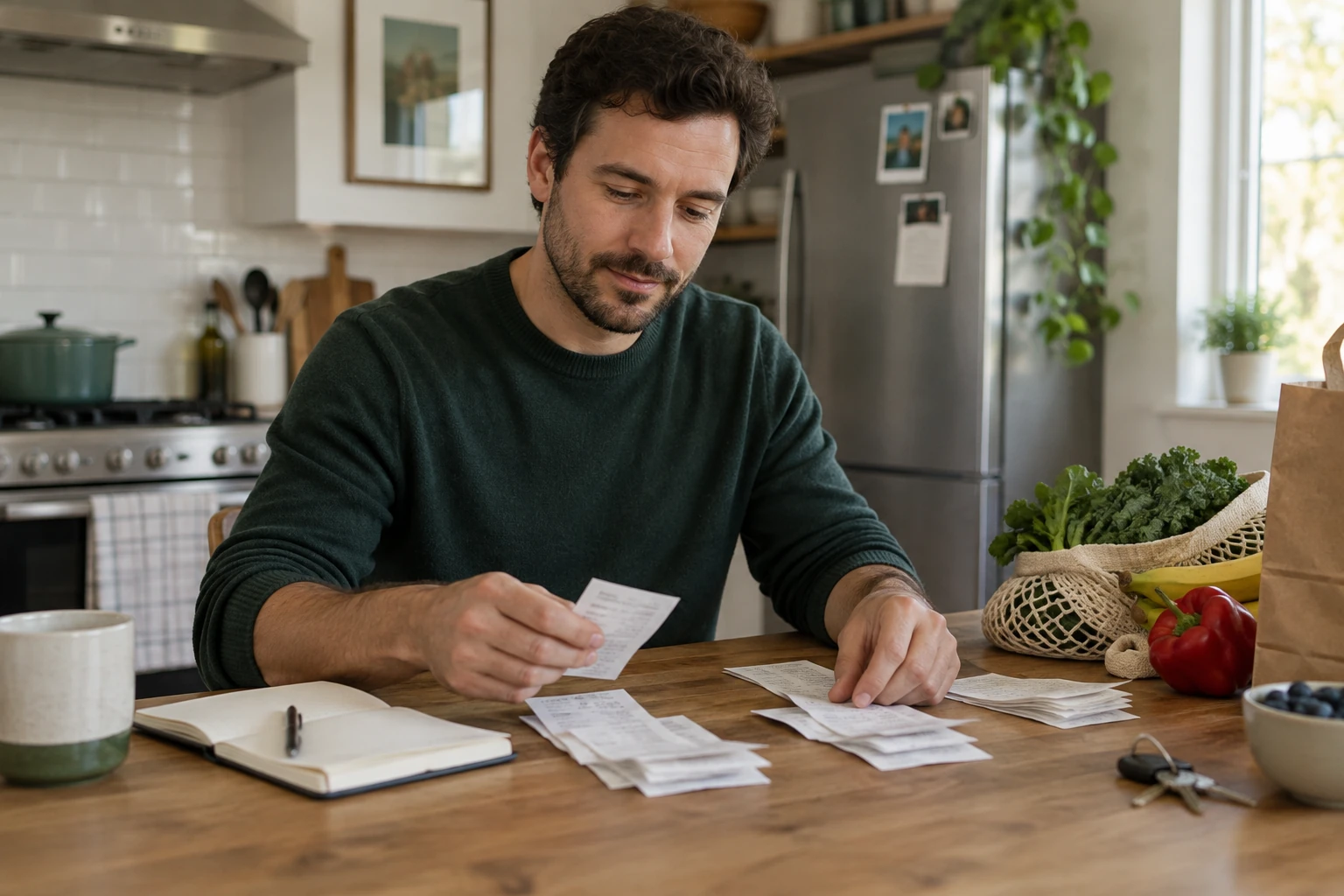

Envelope budgeting gives every spending category its own envelope with a fixed amount in it. When the groceries envelope is empty, grocery spending stops until the next refill. That hard limit is the whole method, and it does not need cash. It does need one change most guides skip: fill the envelopes on payday, from the paycheck that just landed, not on the first of the month.
How does envelope budgeting work?
The classic version is literal. On payday you take cash out of the bank, divide it into paper envelopes marked groceries, gas, eating out and so on, and pay for each category from its own envelope. When an envelope runs out, you stop, or you move money from another envelope and accept that it now has less.
Bills that are paid by transfer, like rent, the car payment and insurance, stay in the bank. The envelopes are for the categories where spending happens a little at a time and adds up without anyone noticing.
The method has had a revival as cash stuffing, with binders and zip pouches instead of envelopes. The mechanics are the same.
Why the envelope system works when other budgets do not
Most budgets are a forecast. You write down that groceries get $500, and then nothing happens when you spend $640. The number was a hope, and the overspend comes out of something else you only notice later.
An envelope turns the number into a limit you can see. You know what is left in the category before you spend, not after the statement arrives. That is the difference: the decision happens at the checkout, while it can still change.
It also makes trade offs honest. Taking $40 from the eating out envelope to cover groceries is allowed. It just means eating out has $40 less, and you can see it.
Which envelope budget categories get an envelope
Give an envelope to anything you spend on in small amounts and tend to overspend. For most people that is a short list:
The biggest variable category for most households, and the one that drifts.
Steady, but easy to lose track of.
Small purchases that add up fastest.
The pharmacy and hardware store runs.
Spending you do not have to justify, so the other envelopes do not get raided.
Fixed bills do not need envelopes; they need to be paid on time. Large costs that come once or twice a year, like car registration or holiday gifts, belong in sinking funds, which are envelopes that fill slowly over many paydays. For a fuller list to choose from, see budget categories.

Fill the envelopes on payday, not on the first
Most envelope guides tell you to fill everything at the start of the month. That only works if you are paid once a month at the start of the month. If you are paid every two weeks, the money for the second half of the month has not arrived yet on the 1st.
So fill each envelope with what it needs until the next payday, from the paycheck you just received. If groceries cost about $500 a month and you are paid every two weeks, each paycheck fills the groceries envelope with about $230, enough for fourteen days. If you are paid weekly, each paycheck fills it for seven.
Do the bills first. Look at what is due before the next payday, set that aside, and fill the envelopes from what is left. If there is not enough for every envelope, you know now, on payday, rather than in the last week of the month. This is the core of paycheck budgeting, and envelopes fit it naturally.
Digital envelope budgeting, without the cash
Cash makes the limit physical, and for some people that matters. It also has real costs: trips to the bank, money that can be lost, online purchases it cannot pay for, and no record afterwards.
The limit is what does the work, not the paper. You can keep the method and drop the cash in a few ways:
Some banks let you open several savings accounts or sub accounts for free. Each one is an envelope.
Groceries go on a card linked to an account that only holds grocery money.
A spreadsheet or an app tracks what is left in each envelope, and you check it before you spend.
Whichever you choose, keep the payday refill and the rule that an empty envelope means stop.
Where envelope budgeting goes wrong
Too many envelopes. Twenty categories is twenty things to track, and the method collapses under its own admin. Start with four or five.
Envelopes set from a wish rather than from what you really spend. If last month's groceries were $640, an envelope of $400 will fail by the second week. Start near the real figure and bring it down.
Raiding without noticing. Moving money between envelopes is fine. Moving it without deciding is how the old overspending comes back. Every move should be a choice you could say out loud.

Doing this in Cashrou
Cashrou plans each pay period on its own. Each payday it shows what is left between now and the next payday after the bills still to come, with a buffer you set held back first. That leftover is what you fill the envelopes from.
You split the leftover into what it is for: groceries until the next payday, fun money, extra on a card, a goal. Whatever you point at a goal or a card updates it. It works on weekly, every other week, twice-monthly and monthly pay.
Cashrou has no bank connection, so it does not see your purchases. You keep the envelopes in your accounts, cards or cash, and the app tells you, each payday, how much there is to put in them.