

A Christmas budget works better built out of paychecks than out of months. Pick a total you can actually fund, count the paydays left before December, and divide. That is the whole method. In mid September that is roughly 13 weekly paychecks, 6 or 7 biweekly, 6 twice-monthly or 3 monthly, and which one you get changes everything.
Gift budgets are holding, the buffer behind them is not
PwC's Holiday Outlook 2026 has consumers expecting to spend $708 on gifts this year, a dip of 2% on last year. Households with children expect to spend $875, households without, $635. Gift spending is close to flat.
What has moved is what sits behind it. The US personal saving rate fell from 4.5% in January 2026 to 2.7% in June 2026, according to the Bureau of Economic Analysis. The holiday is the same size. The cushion paying for it is around half what it was.
That gap is the problem worth solving. When the total holds and the buffer thins, the difference goes on a card in December and is repaid with interest through spring. That is not a spending problem. It is a timing problem, and timing is fixable in September.
Set your Christmas budget before you pick the presents
Most people do this backwards. They make a list, buy from it, and find out what Christmas cost in January.
Decide the total first. The $708 above is a national average, not a target. The right number is the one your remaining paychecks can carry without something else breaking.
Write down everyone you buy for with a figure beside each name. Then add what never makes the list: food, travel, decorations, postage, wrapping. That total is what you are funding.
How many paychecks are actually left
This is the step most guides skip, because most guides are written in months. In mid September there is no January left to start from.
Count from your next payday to the last one that lands before you need the money. For most people that is the middle of December rather than the 25th, because gifts get bought before they get given.
Then count the real paydays on a calendar rather than dividing the year by twelve. If an extra payday falls inside that run, it is worth knowing before you plan around it, because it changes what each of the others has to carry.
Weekly, biweekly, twice-monthly and monthly
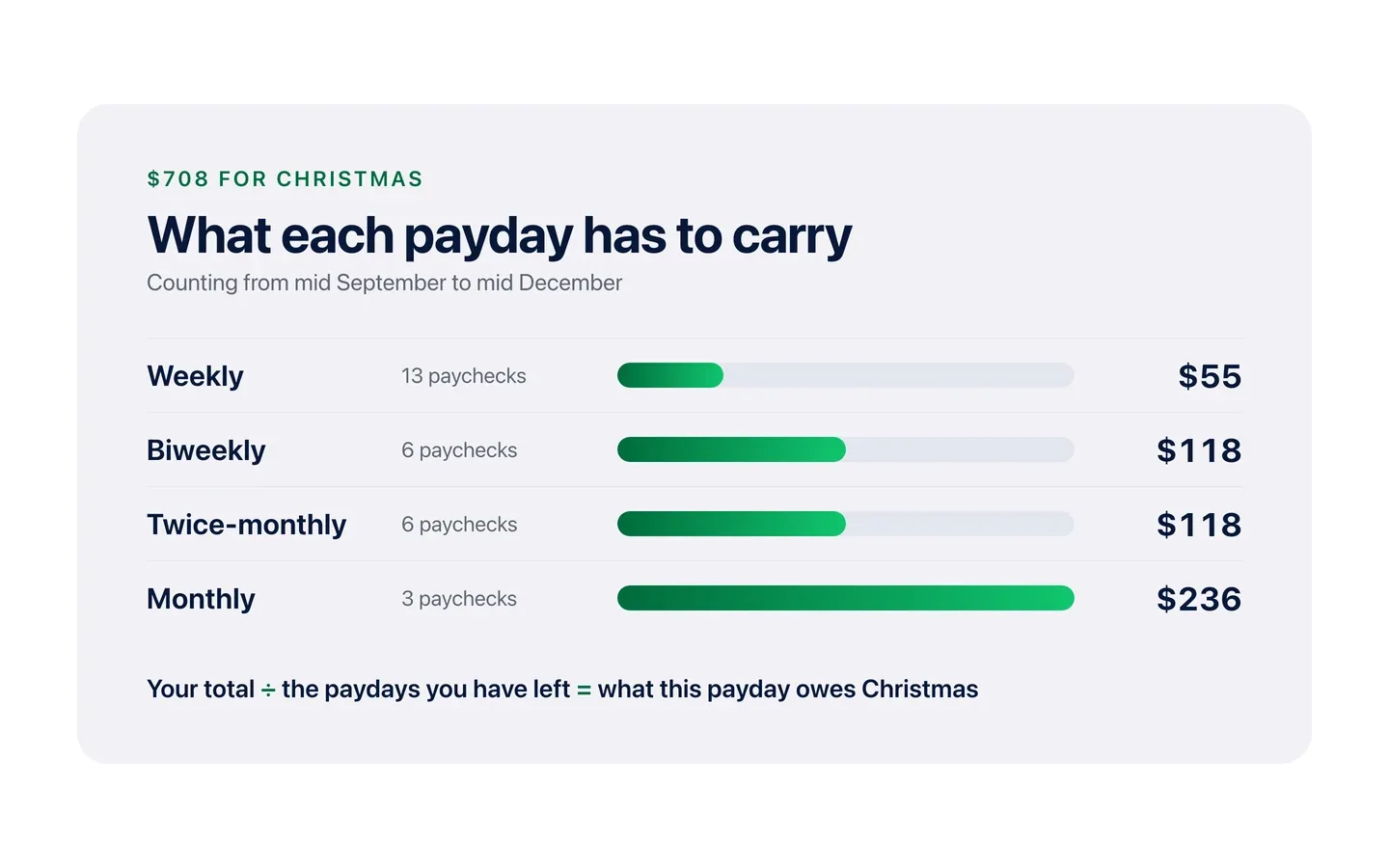
The same $708 looks completely different depending on how you are paid. Counting from mid September to mid December:
About 13 paychecks. That is $708 ÷ 13, or about $55 a week.
Six or seven, depending where your cycle falls, so check a calendar. Six means $118 each, seven means $101.
Six paychecks, whether you are paid on the 1st and 15th or the 15th and the last day. That is $118 each.
Three paychecks. That is $236 each.
Monthly is the hard one, in a way month-based advice hides. Three paydays means $236 from each, and the last may land after you have bought most of it. September and October are doing the work.
Your total ÷ the paydays you have left = what this payday owes Christmas.
Where the money sits until December
Somewhere you will not spend it, and not in checking alongside the grocery money.
One separate savings account is enough. You do not need one per purpose. What matters is that the balance has a name, so that $400 in October reads as "Christmas, most of the way there" rather than as spare money.
What you are building is a sinking fund, the general version of this for any known irregular expense. Christmas is the easiest one to justify, because the date has never once moved.
What to cut if the number does not fit
Sometimes the total divided by the paydays gives a figure the paycheck cannot carry. That is useful information in September and useless in December.
Three moves, roughly in order of how much they hurt:
Fewer people at a gift worth giving beats everyone at a worse one.
Travel is where the money quietly goes. PwC has expected holiday travel spend down 24% this year, to $419 from $553, so a lot of people have already reached this conclusion.
A subscription audit in September funds a real part of December by the time it arrives.
If you do not know which categories have slack, a list of what a budget usually contains beats staring at a bank statement.
Starting in November, when the arithmetic is tighter
Starting late costs more per payday, and no method changes that.
In November a monthly earner has one paycheck left before Christmas. A weekly earner has about six. The same total comes from fewer places, so either the total comes down or something waits until the new year. Both are decisions. Neither is a failure.
What does not work is planning to catch up in December. December is the month the money leaves.
Doing this in Cashrou
Cashrou plans each pay period on its own, so it answers the question that matters in September: after the bills still to come, what is left between now and your next payday.
Set up a goal for the holiday with the date and the amount. Cashrou spreads that number across the paydays you genuinely have left rather than across the months, and it handles weekly, biweekly, twice-monthly and monthly pay, so the count is yours rather than an average. The goal reads its progress from the account holding the money, so it stays right without being maintained.
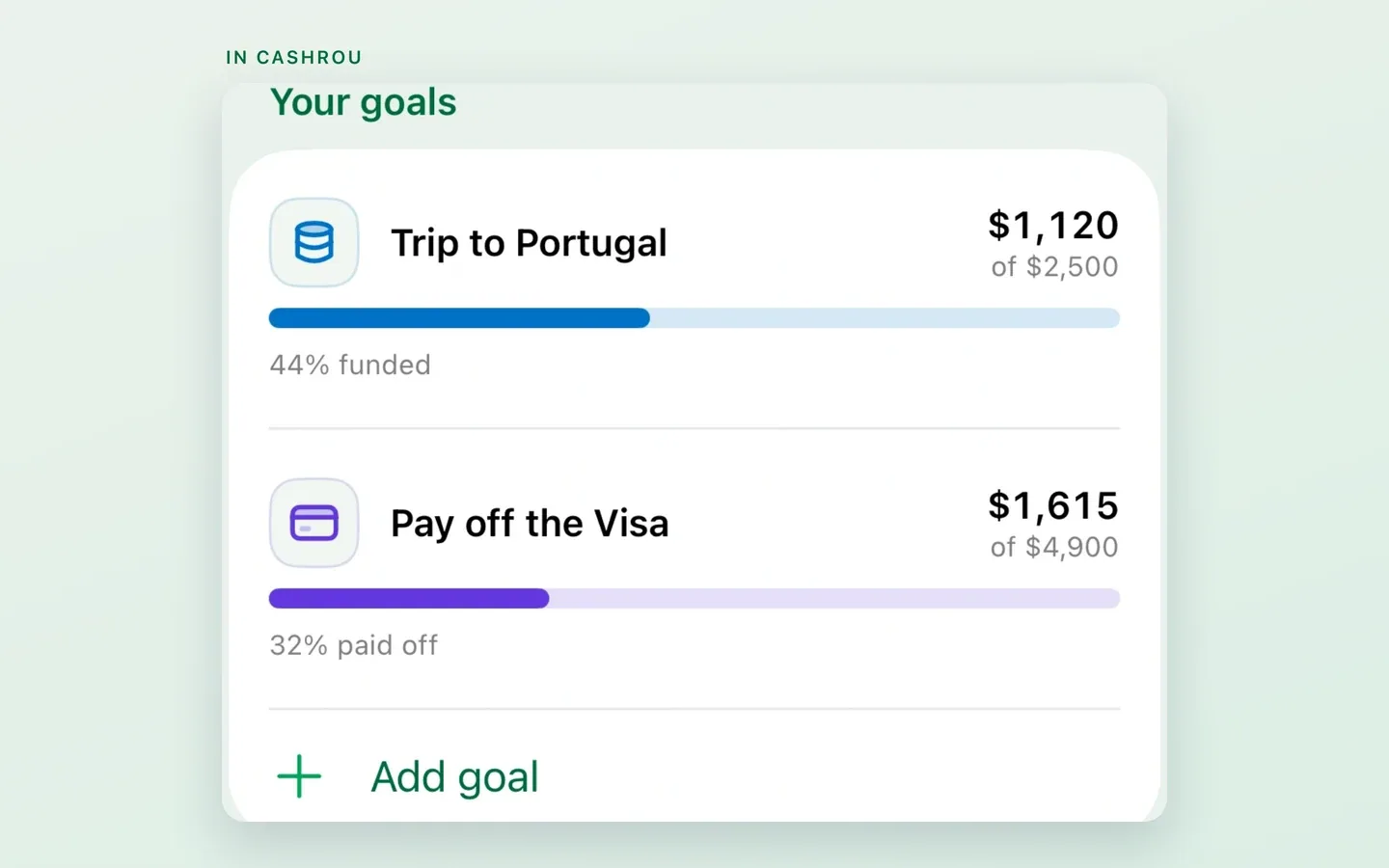
Then point part of each payday's leftover at it. A monthly budget cannot show you this, because what you need to see is which specific paycheck is carrying which part of December.