

Yes, budgeting apps are safe to link to your bank, and safe is the wrong thing to be asking about. The connection is read only, the app never sees your bank password, and the encryption is not where this goes wrong. What you are deciding is how much of your financial history you hand over, and to whom.
Are budgeting apps safe? The short answer
Yes, with two conditions that are usually met and one that often is not.
Most apps do not build their own link to your bank. They use an aggregator, and Plaid is the largest. You type your credentials into the aggregator's screen rather than the app's, and it returns a token. The app reads balances and transactions with that token. It cannot move money.
That covers the fear most people arrive with, which is that someone will empty the account. It does not cover the one that matters more: your data is now in three places instead of one, and what happens to it is decided by whoever you handed it to.
What Plaid actually does when you link an account
Plaid sits between several thousand apps and your bank. It holds the credential or the bank-issued token, fetches your account data on the app's behalf, and passes on what the app asked for.
The detail worth knowing is that Plaid is the party with the bank relationship, not the app. If the app you chose shuts down tomorrow, the connection does not close with it unless somebody revokes it. Plaid runs a portal where you can see your connections and delete them.
Plaid is a real company with real security engineering. Treating it as a scam is wrong, and so is treating it as a neutral pipe.
What it collects, and the 2022 settlement
The uncomfortable part, and a matter of public record.
In 2022 Plaid paid $58 million to settle a privacy class action in the Northern District of California, In re Plaid Inc. Privacy Litigation. The claim was that it obtained bank login credentials and collected more account data than people understood they were agreeing to, across accounts linked between January 2013 and November 2021. Plaid did not admit liability. It agreed to delete certain data, hold less of it, and tell people about the portal where connections can be managed.
That is not a reason to refuse every connection. It is a reason to read what you are agreeing to, and to assume the scope of a link is wider than the one feature you wanted it for.
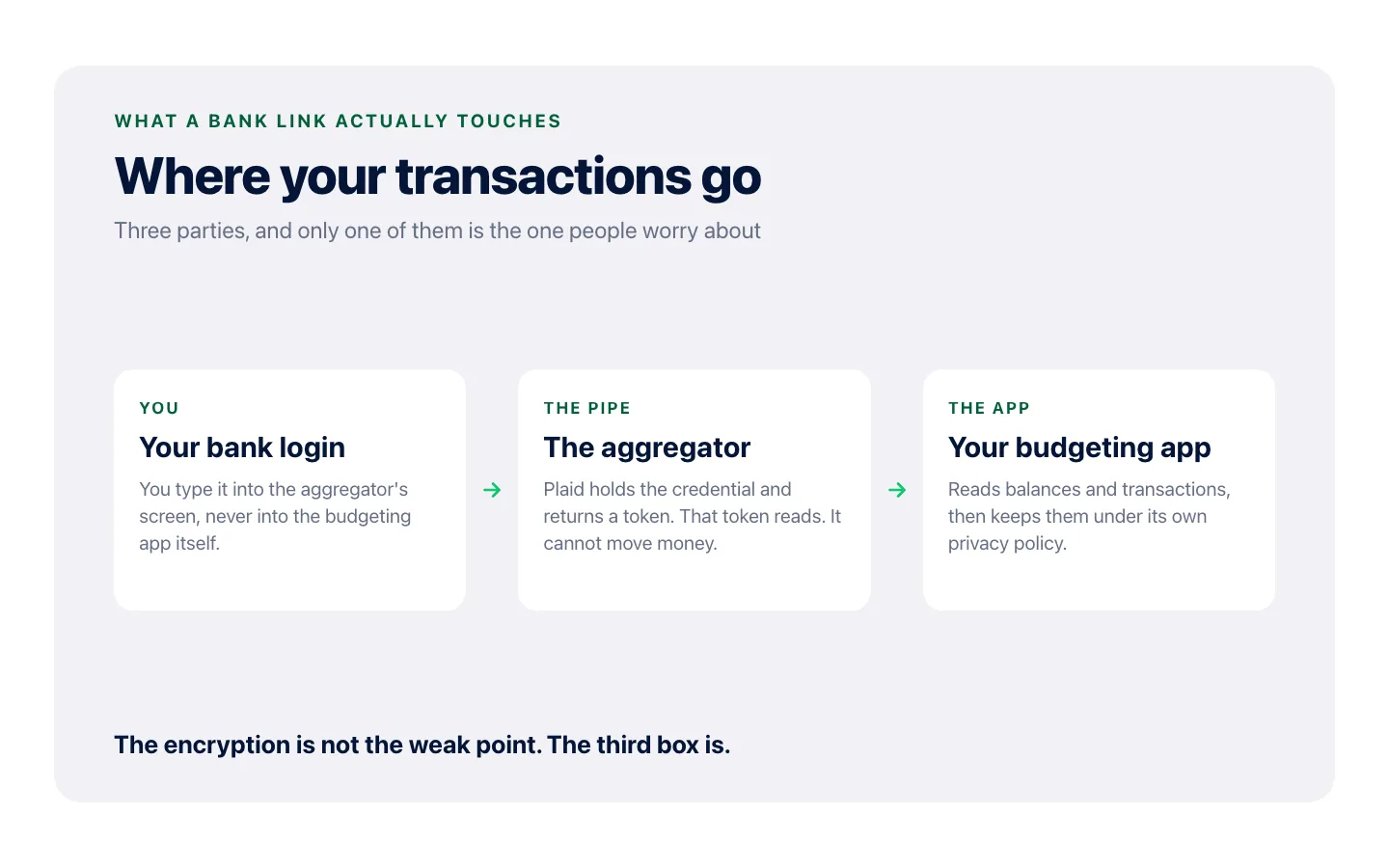
The risk is usually the app, not the pipe
Once the data reaches the app, the aggregator's rules stop applying and the app's begin. Three things to look at.
Not what the aggregator says. They are two different documents, and only one of them governs your transaction history now.
A privacy policy that shares data "with partners" for analytics or marketing is telling you the data leaves.
Some budgeting apps belong to larger financial companies, and a business that also lends money has a use for your spending history that has nothing to do with your budget.
Then know that deleting the app does not revoke the connection. That is the common practical failure. People stop using a budgeting app and the link keeps working for years.
Questions to ask before you link anything
Four, and they take about ten minutes.
Most linking flows take everything by default.
The aggregator's portal, not only the app's settings.
Deleted, anonymised, or kept.
If the only benefit is not typing, that is a fair trade for some people and a poor one for others.
What you give up if you do not link, and what you get back
Manual entry costs real minutes. Bills are entered once, so what is left is the variable spending, and for most people that is a few minutes a week. Anyone who says it costs nothing has not done it. What you get back is three things, and only the first is about privacy.
No token, no third party with standing access, nothing to revoke in two years.
Bank connections fail constantly. Logins change, banks update their systems, and an app shows stale balances until you happen to notice. A number you typed does not go stale.
Entering an expense is the moment you notice it. Automatic import is better at record keeping and worse at attention, and attention is what changes your spending.
Most of the work is writing the bills down once. If you have never done that, a list of the categories worth tracking is a faster start than inventing one.
Who should skip bank connections entirely
Not everybody needs to. If typing bothers you and your finances are simple, a connection is a reasonable trade. Skip it if any of these are true.
Your business and personal money share an account, so an aggregator would hold your business data too
Somebody else having sight of your financial history would put you at risk
Your bank charges for third party access, or blocks it
You have tried it and spent more time repairing broken connections than budgeting
Doing this in Cashrou
Cashrou has no bank connection to offer. That is a decision rather than a missing feature, and it is why the question this article answers never comes up here.
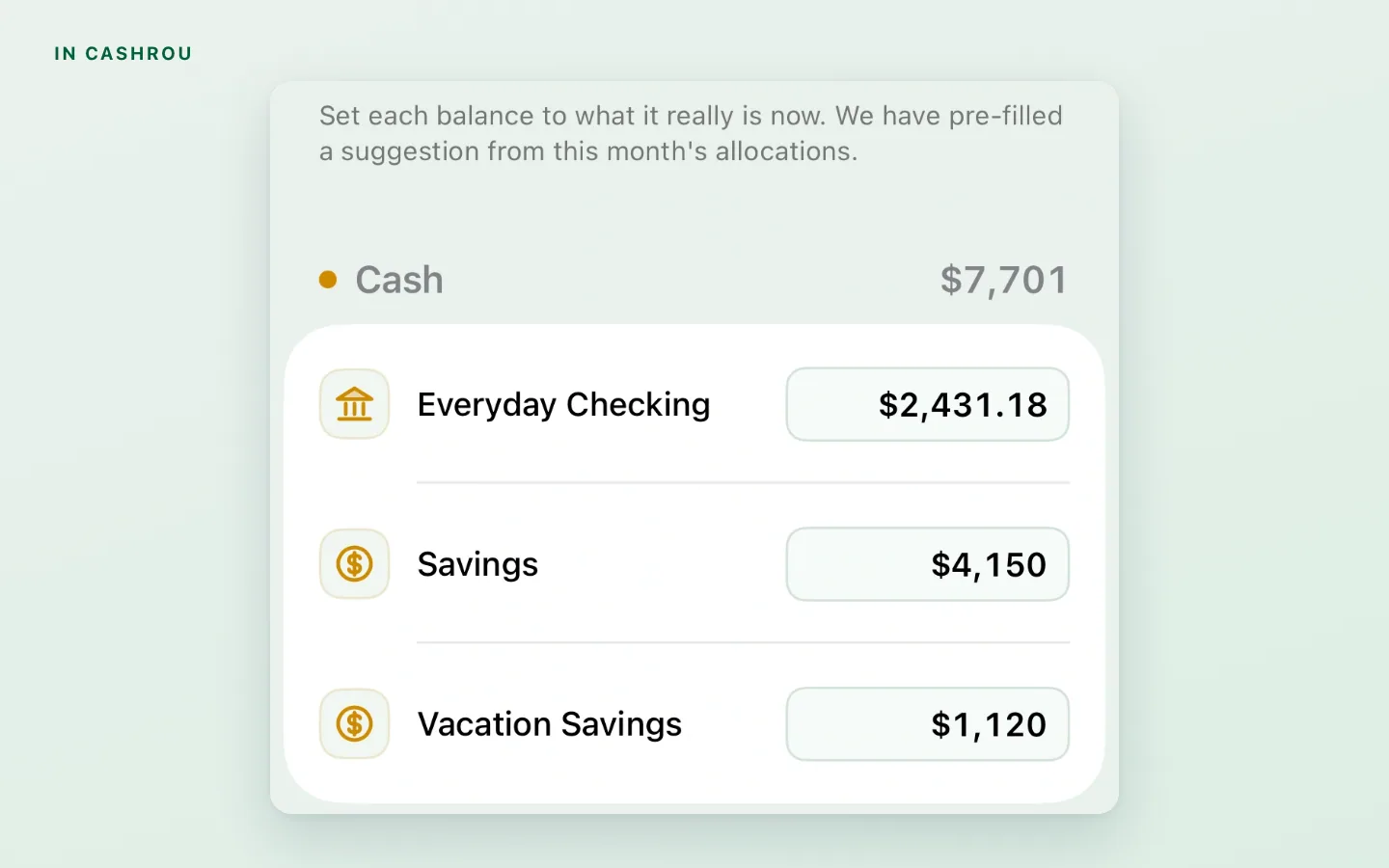
You enter what you earn, when you are paid, and what you owe. Cashrou plans each pay period from that: what this paycheck has to cover before the next one, and what is genuinely left. Nothing is fetched, so there is no aggregator holding a copy and no connection to revoke later.
The cost is that you type the numbers. What you get is a plan built from what you owe rather than from what you already spent, which is the direction that moves you off living paycheck to paycheck.
The features page says what Cashrou does and what it does not, and the pricing page says what it costs.