
Why they happen
You are paid every 14 days, which is 26 paychecks a year. Twelve months, 26 paychecks: ten months hold two and two months hold three.
It is arithmetic, not luck. It happens every year, to everybody paid fortnightly, and it is entirely predictable in advance.
When yours are
They depend on the weekday you are paid and the date of your first payday of the year, so they differ between people paid on the same schedule.
Working yours out takes a calendar and one real payday: count forward in fourteens for a year, and the two months that catch three paydays are the ones to plan around.
Do this now rather than in the month itself. The whole value is in deciding early.
Why it disappears
Your monthly bills are covered by two paychecks, because monthly bills are sized to a monthly income. So the third one arrives with nothing claiming it.
Money with nothing claiming it does not stay. It is absorbed by a slightly better month: a few more meals out, a bigger shop, the thing you had been putting off. None of it feels like a decision, which is exactly the problem. You cannot point at what it went on.
If your budget is monthly, this is worse, because the month simply reports a surplus and the surplus never becomes anything.
What to do with it
In order, and take the first one that applies.
1. If you have no buffer, this is the buffer
A month with an extra paycheck is the easiest month of the year to start one. One paycheck of buffer is the difference between a surprise being annoying and a surprise being a crisis.
2. If you have high-interest debt, put it there
A whole paycheck against a card at 22% is worth more than the same paycheck against almost anything else. It is not exciting and it is the right answer.
The reason it works better than an extra $200 a month is that it lands as a lump: it comes off the balance before another cycle of interest, and it moves your debt-free date by more than the arithmetic suggests.
3. If your sinking funds are behind, catch them up
Car costs, Christmas, the annual renewals. Sinking funds fail because they are underfunded from the start, and a third paycheck fills the gap in one go.
4. Then, and genuinely, spend some of it
Not all of it. But a plan that assigns every windfall to duty is a plan people abandon.
A common split is 80% at whichever of the above applies and 20% on something you actually want. The 20% is what makes the other 80% survivable, and anyone who tells you otherwise has not tried to keep this up for a year.
Decide before it lands
The one rule. Write down what the third paycheck is for while it is still two months away.
A paycheck with a job written down beside it gets that job. A paycheck that arrives while you decide what to do with it has already been spent by the time you decide.
The same trick for weekly pay
Paid weekly? 52 paychecks, 12 months, so four months a year hold five paychecks. Same arithmetic, same opportunity, four times instead of twice.
Doing this in Cashrou
Cashrou plans each pay period separately, so a third paycheck shows up as what it is: a pay period with income and almost no bills against it, and a large leftover.
From there, the leftover splits into what it is for: extra debt payment pointed at a specific card, a goal, or fun money. Whatever you point at a card or a goal updates it.
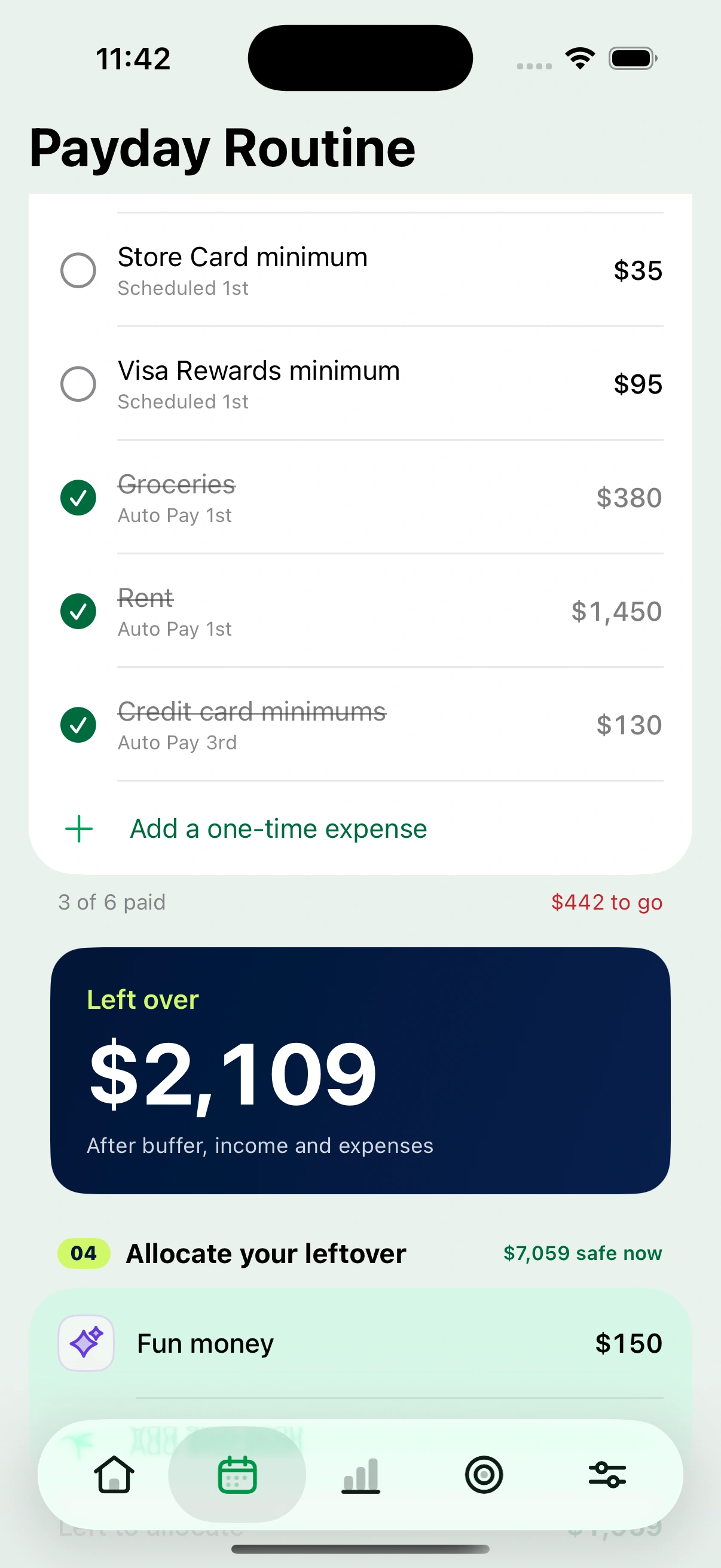
That is the difference from a monthly budget. A monthly budget tells you the month went well. A payday budget tells you there is $2,100 sitting in one pay period with nothing claiming it, which is a much harder thing to ignore.
The short version
- Two months a year hold three paychecks; four months if you are paid weekly
- They are predictable, so find yours now
- Buffer first, then high-interest debt, then sinking funds
- Spend a fifth of it on purpose
- Decide before it arrives, or it is gone