
Work out which problem you have
Add up everything that has to be paid in a month: rent, utilities, food, transport, minimum debt payments, insurance. Nothing optional.
Compare it to what actually lands.
If outgoings exceed income, this is an income problem. Budgeting harder will not solve it, and any article that tells you it will is wasting your time. Skip to the last section.
If income exceeds outgoings but you are still empty before payday, this is a timing problem, and it is fixable. Most people who feel they live paycheck to paycheck are here.
The timing problem
You are not short of money over a month. You are short of money on the days the bills land.
Rent goes out on the 1st. Your paycheck arrives on the 5th. For four days you are underwater, so something goes on a card. The card minimum then takes a slice of the next paycheck, and the gap gets slightly wider each cycle.
Nothing about your spending has to change for that to keep happening. It is a scheduling failure.
Fixing it, in order
1. Map your bills against your actual paydays
Write your next six paydays down as real dates. Then put each bill against the last payday before it is due.
You will find one pay period carrying far more than the other. That imbalance is the problem, made visible.
If you are paid every two weeks, the date arithmetic is in how to budget on a biweekly paycheck, along with the full method.
2. Move a due date
The cheapest fix available, and the most underused.
Most utilities, phone companies, insurers and card issuers will change your due date if you ask. One phone call moves a bill from the tight pay period to the loose one, permanently, and costs nothing.
Do this before anything else. It is the highest return on effort in this entire article.
3. Build one week of buffer
Not three months. One week of ordinary spending, sitting in your checking account, untouched.
One week is enough to stop the cycle: the bill that lands before payday comes out of the buffer instead of a card, and the card stops taking a slice of the next paycheck.
Three months is a good long-term target and a terrible starting one. People aiming for three months save nothing because it looks impossible. People aiming for one week get there, and one week is where the compounding stops working against you.
4. Deal with the minimums
Once the buffer exists, look at what your minimum payments cost you monthly. That figure is the tax the previous cycle is charging the current one.
Snowball or avalanche, either works, and pick the one you will keep doing. What matters more is that anything above the minimum goes at one debt rather than being spread evenly across all of them.
5. Fund the predictable irregular things
The car insurance, the annual renewals, Christmas. If those are hitting the buffer, sinking funds are the fix, and without them the buffer gets drained every few months and you start again.
6. Use the three-paycheck months
If you are paid fortnightly, two months a year deliver a paycheck your monthly bills do not need. Those two months will build your buffer faster than the other ten combined.
What the app does
Cashrou is built for step one and keeps it current afterwards. It plans each pay period separately, holds back a buffer you set before calling anything free, and shows what is left between now and the next payday.
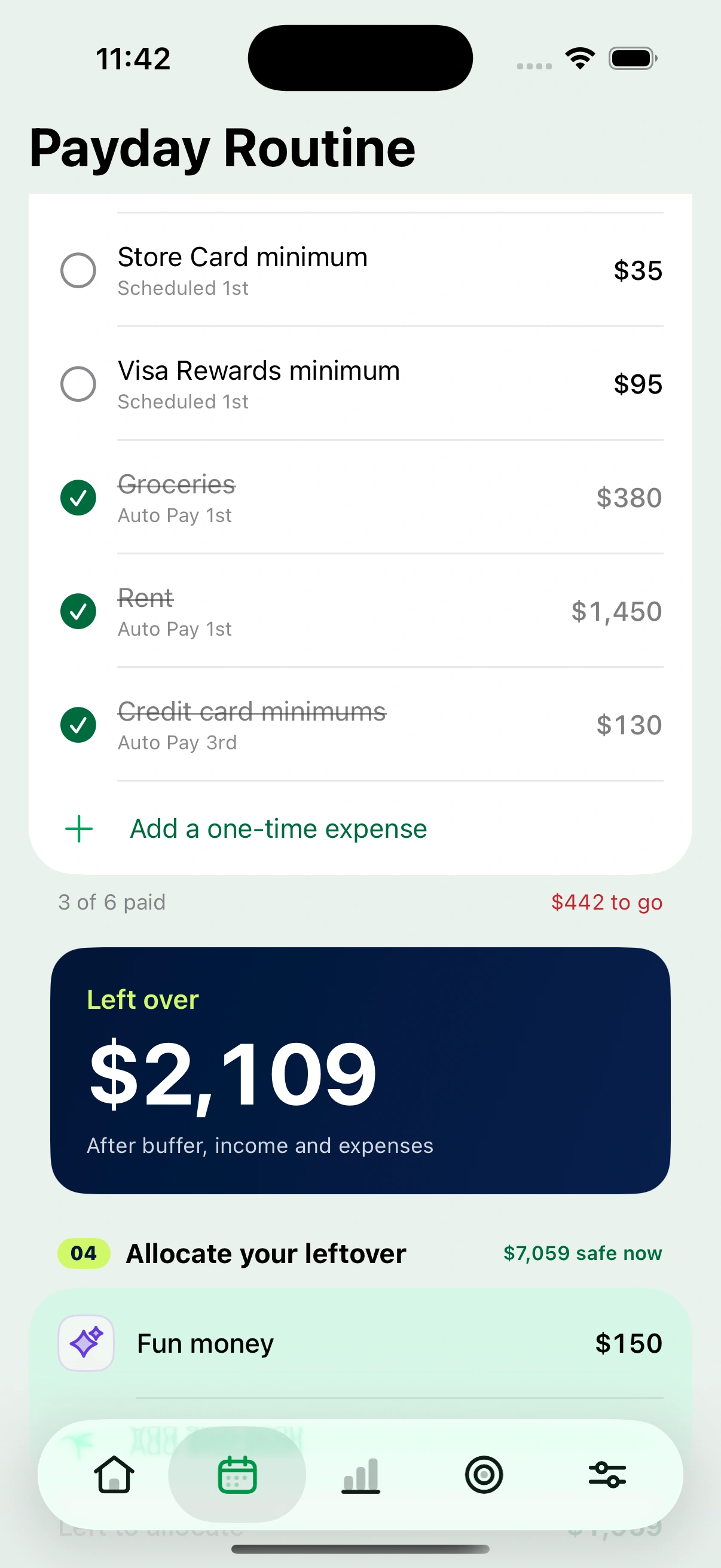
The buffer setting is the part that matters here. Set it to a week of spending and the app will not tell you money is available when it is standing between you and the 1st.
If it is an income problem
Say it plainly: if your necessary costs exceed your income, no method on this page fixes that, and being told to budget better when the arithmetic does not work is insulting.
The things that do change it are lowering fixed costs (housing and transport, which is where the real money is and where the hard decisions live), raising income, or getting help. In the US, 211.org connects to local assistance for rent, utilities and food, and non-profit credit counselling through the NFCC is free and is not a debt-settlement pitch.
Neither of those is a budgeting app, and neither of them is a failure.
The short version
- Check whether it is a timing problem or an income problem
- Map bills against real paydays
- Move a due date, it is free
- One week of buffer, not three months
- Fund the predictable irregular things or the buffer keeps draining
- If the arithmetic genuinely does not work, get help rather than budget harder