
What a sinking fund is
Money set aside a bit at a time for a specific expense you know is coming but which does not arrive monthly.
Car insurance is due once a year at $840. You can pay $840 in March and feel it, or you can put $70 aside every month and pay it from a pot that is already full. The second one is a sinking fund.
That is the whole idea. It has an old-fashioned name from corporate finance and it is not complicated.
How it differs from an emergency fund
People mix these up constantly, and the difference is the entire point.
An emergency fund is for the unknown. Job loss, a boiler, a hospital bill. You do not know what it is or when.
A sinking fund is for the known. You know Christmas is in December. You know the car needs tyres eventually. You know the insurance renews.
If your emergency fund is being drained every few months, it is usually not an emergency fund problem. It is that predictable expenses are being treated as emergencies. That is the fix sinking funds make.
Which ones are worth having
Start with the ones that have actually caught you out. That list is personal, but these catch most people:
Car. Insurance, registration, tyres, servicing, the repair you know is coming. Often the single biggest gap in a household budget.
Christmas and birthdays. Entirely predictable, and the reason January credit card balances spike every year.
Annual subscriptions. The $139 that lands once a year and always feels like a surprise. If you have several, one fund covers them all.
Home maintenance. If you own, this is not optional. A rough rule is 1% of the property value a year, though what matters more is that the number is above zero.
Medical. Deductibles, dental, glasses. Predictable in aggregate even when individually surprising.
Travel. The wedding you will be invited to, the flight home for the holidays.
How many is too many
More than about eight and the system starts costing more attention than it saves.
The failure mode is real: people set up nineteen sinking funds, spend an hour a month moving small amounts between them, and abandon the whole thing within a quarter. A fund for $12 a month is not doing enough work to justify existing.
Combine the small ones. “Car” beats separate funds for tyres, servicing and registration. “Gifts” beats one per relative.
Only fund what has actually gone wrong. If you have never once been caught out by pet costs, you do not need a pet fund.
Working out the amount
For each one: total annual cost, divided by how many times you are paid in a year.
Not divided by twelve, unless you are paid monthly. If you are paid every two weeks, divide by 26. If you divide by twelve and then set aside that amount each payday, you will over-save by about 8% and wonder why every fortnight feels tight.
Car costs of $1,600 a year, paid fortnightly: $1,600 ÷ 26 = $62 a payday.
Where to keep the money
One savings account is enough. You do not need an account per fund, and opening nine accounts is the fastest way to abandon the system.
Keep one savings account, and track what the balance is for in whatever you use to budget. The bank does not need to know the money has a name; you do.
The exception is money you would otherwise raid. If having it visible in checking means it gets spent, move it somewhere with a small amount of friction.
Doing this in Cashrou
Two pieces, and the second is the one that keeps it honest.
The recurring bill. Enter the annual expense as a bill on the payday it is actually due. It appears in the right pay period rather than as a surprise.
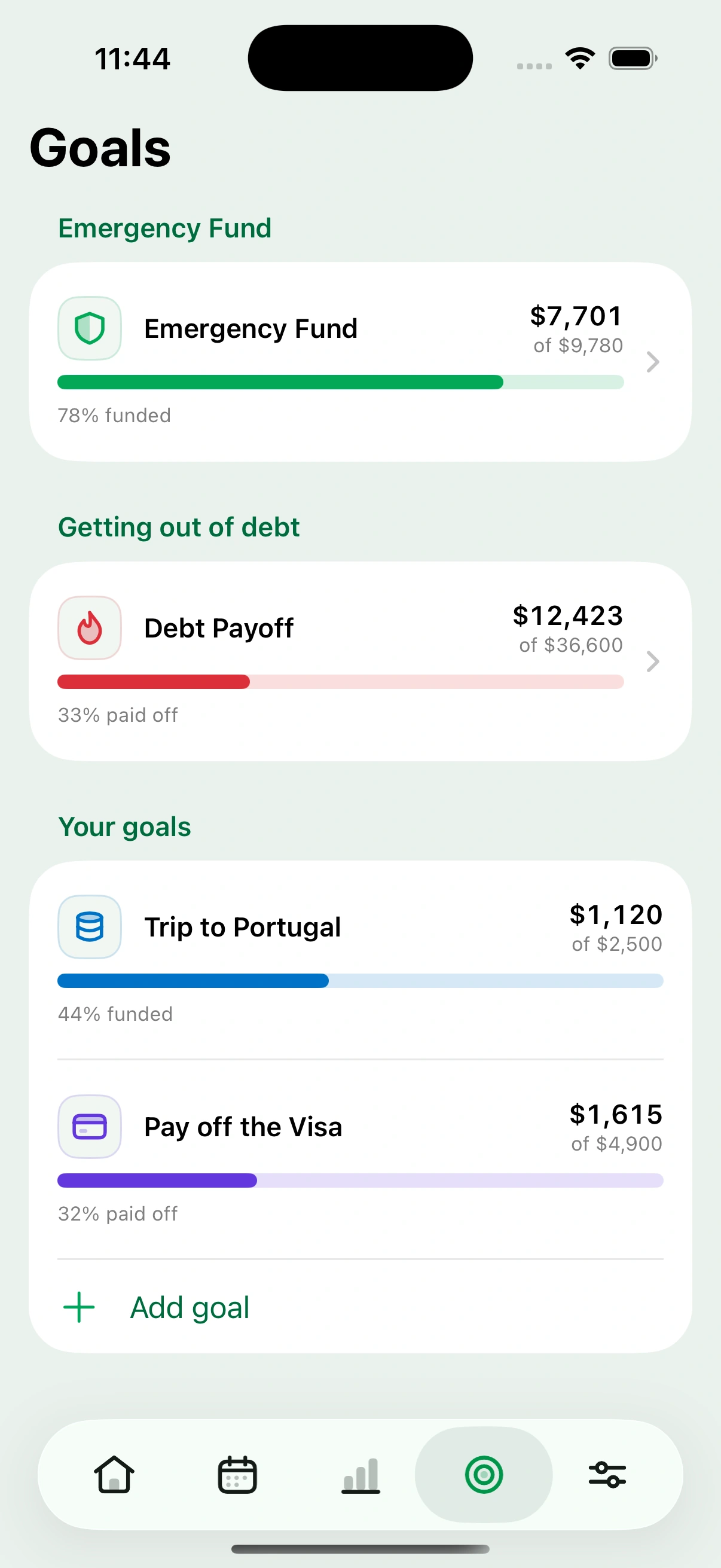
A goal linked to the account holding the money. Cashrou reads the balance, so the progress bar is right without being maintained. Point part of each payday’s leftover at it from the payday screen.
The subscription list also does the annual-to-monthly arithmetic for you: a $139 yearly charge shows as its true monthly cost alongside everything else, so the total you see is what your subscriptions really cost rather than what this month happened to charge.
The short version
- Sinking funds are for known irregular expenses; emergency funds are for unknown ones
- If your emergency fund keeps draining, you probably need sinking funds instead
- Start with car, gifts and annual subscriptions
- Divide the annual cost by the number of paydays, not by twelve
- One savings account is enough
- Fewer than eight, or you will stop