
The mismatch
Almost every budgeting app starts by asking for your monthly income. You do not have one. You have a number that was $4,100 in March, $1,900 in April and $3,300 in May, and no way of knowing what June is.
So you give it an average, and from that moment the app is describing a month you have never had. In a good month it tells you that you are fine when you should be putting the difference away. In a bad month it tells you that you have overspent when what actually happened is that the work paid late.
The problem is not that you cannot predict the income. It is that you cannot tell, on any given day, whether you are ahead or behind, so every decision feels like a gamble.
What Cashrou does differently
It counts what has landed, not what was expected. Income is ticked as it arrives. Until a payment is ticked it is not in the figure at the bottom, so that figure is never propped up by money a client has promised.
The buffer does the work an average cannot. You set an amount Cashrou holds back before it calls anything free. Set it to a month of your fixed costs and the app will not tell you money is spare when it is next month’s rent.
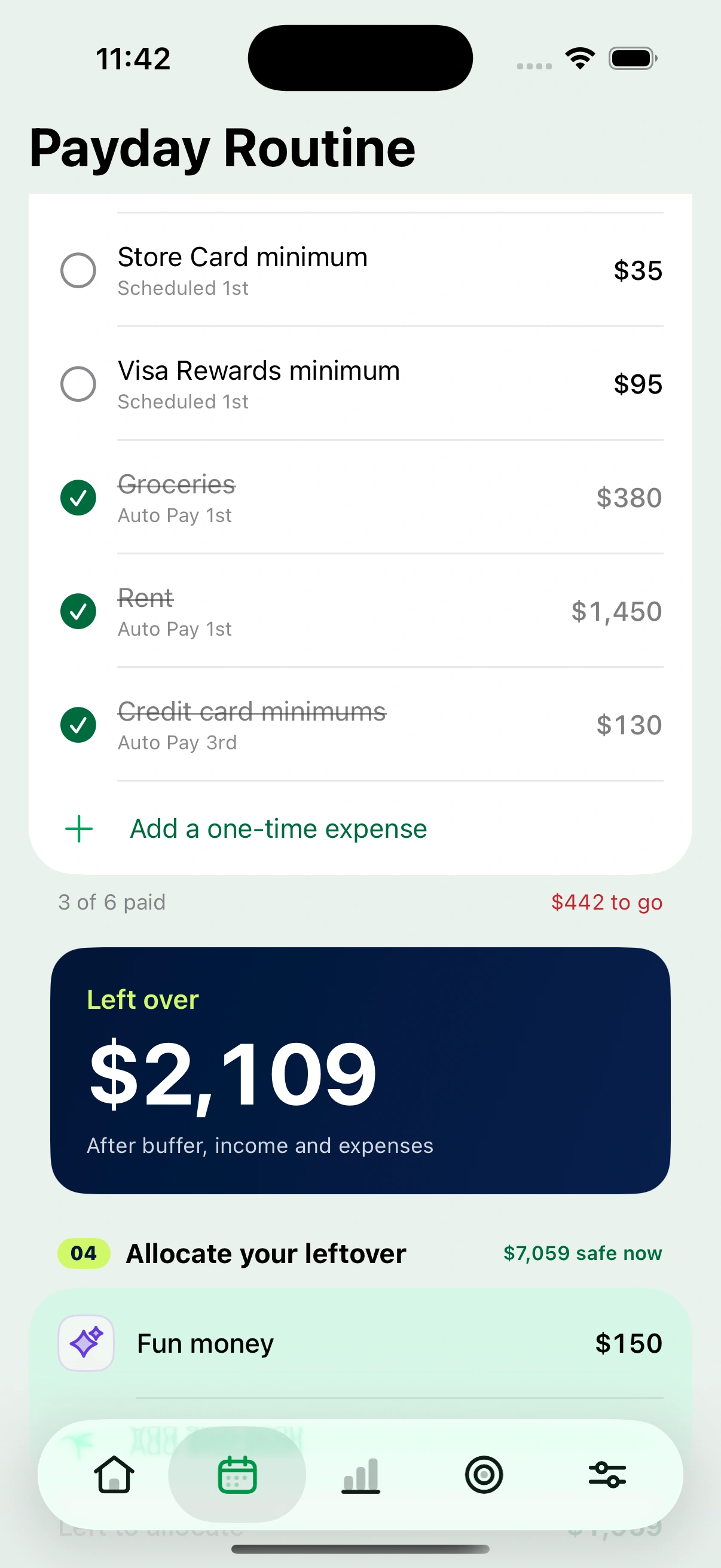
Bills you have to pay are subtracted whether or not the work has paid. What is still committed comes off the top. The leftover is what is free after everything already claimed, not before it.
Money that passes through you does not count as yours. A client payment that includes expenses you have to pay on, or a project where part of it belongs to somebody else, is recorded as reimbursed rather than income.
Set the rhythm to the day you pay yourself. If you have got as far as paying yourself a fixed allowance on a fixed date, that is a real payday and Cashrou treats it as one. Before that, set it to monthly and use the routine to track what has landed against what is still due.
What is the method behind this?
Five steps, on paper and free to read: work out your floor, get fixed costs under it, treat everything above it as unassigned, build one month of buffer, then pay yourself on a fixed day. It is written up in how to budget on an irregular income.
The app is what makes the middle of that survivable day to day. The method does not need it and works with a spreadsheet.
Will it forecast what I am going to earn?
No. Cashrou has no model of your client pipeline and does not try to guess what next month brings. It tells you what has landed, what is committed, and what is left.
For a lot of people with variable income that is the whole problem solved. If what you want is a projection, this is not the tool.
How long does setting it up take?
Three questions, once: how often you are paid, your accounts and bills, and the buffer you want held back no matter what. Most people are set up in under twenty minutes, and an import from a spreadsheet or a bank export does the boring half.
Then a few minutes each time money lands. Tick it, tick what has cleared, read the figure at the bottom.
What do I give up by not connecting a bank?
Cashrou never asks for your bank login and holds no read access to your accounts. You confirm your balances yourself, which takes about a minute and means there is no credential of yours for anyone to lose.
The trade is real: no automatic transaction feed and no automatic categorising. If that is what you want, you want an app that connects to your bank, and Cashrou is not one.
What does it cost?
$4.99 a month or $49.99 a year, with seven days free. If your income is genuinely unpredictable, use the trial to run one full cycle from a real payment to the next. Full pricing.